
In price negotiations, many people prefer to wait for the other side to open. Three experiments by Adam Galinsky and Thomas Mussweiler showed that the party making the first offer tends to come out ahead, and what takes that advantage away.
Picture a buyer negotiating next year’s prices with a packaging supplier. She arrives well prepared. She knows how much the company bought last year, she has prices from two competitors and she has a number in mind she would be happy with. But she decides to let the other side go first. Let the supplier show what he has brought.
The supplier’s sales director smiles, opens his folder and says: „Given the price of paper and energy, we need to go up by fourteen per cent.“ From that moment, the negotiation is about whether it will be nine or eleven. The buyer leaves with eight per cent and the sense that she has negotiated six points off. The number she came with was never mentioned in the whole hour.
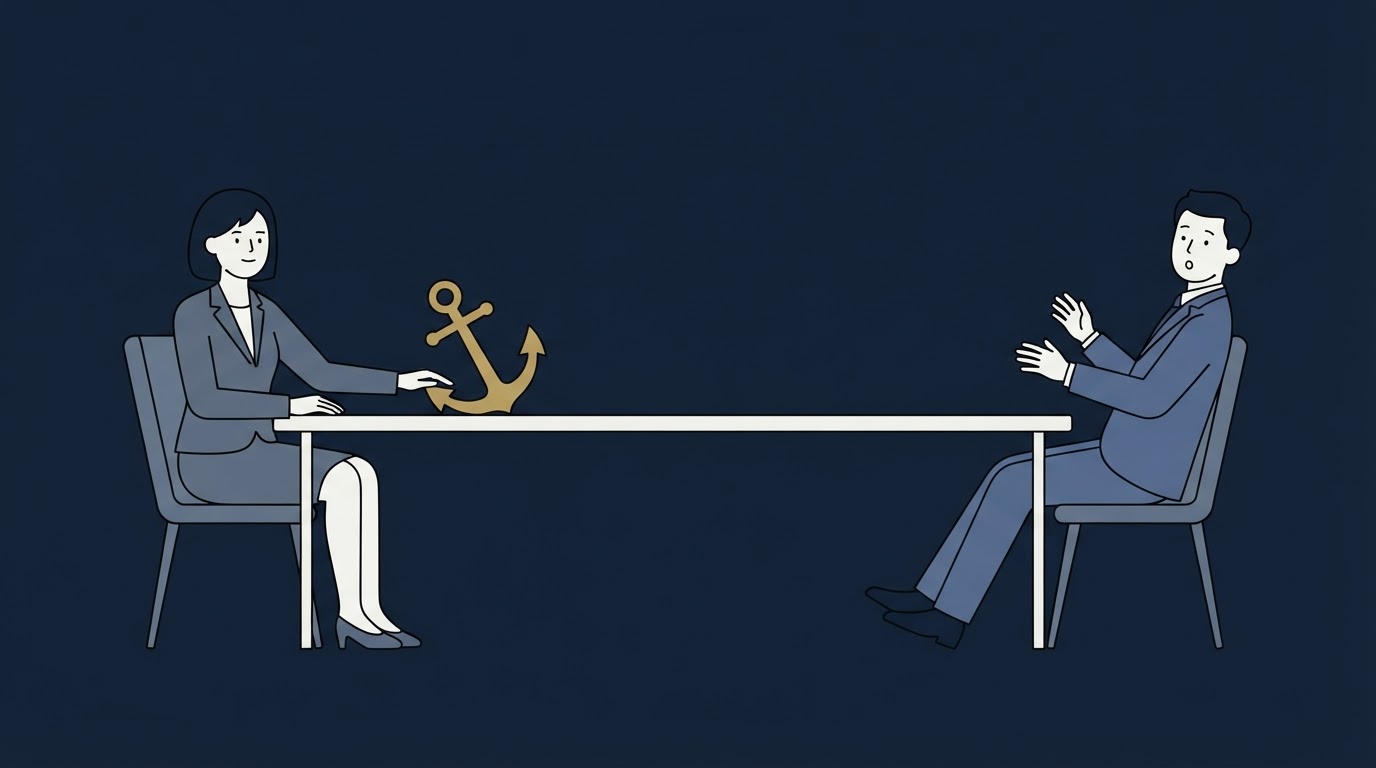
The number that sets the frame
Adam Galinsky of Northwestern University and Thomas Mussweiler studied first offers in three experiments, published in 2001 in the Journal of Personality and Social Psychology.1 Participants negotiated a price as buyers and sellers, both face to face and by email. Across the three experiments, the party that made the first offer achieved the better outcome, whether buyer or seller. The first offer also strongly predicted the final price.1
Continue reading
Read the full article for free
Enter your email and the full article opens straight away. No payment, just a subscription to TORVAKO Insights.
- Full articles with all the sources they draw on
- Once a month, an overview of new articles and one story from practice
- You will be the first to receive TORVAKO study results
Already a subscriber? Enter your email and the article will unlock on this device too.